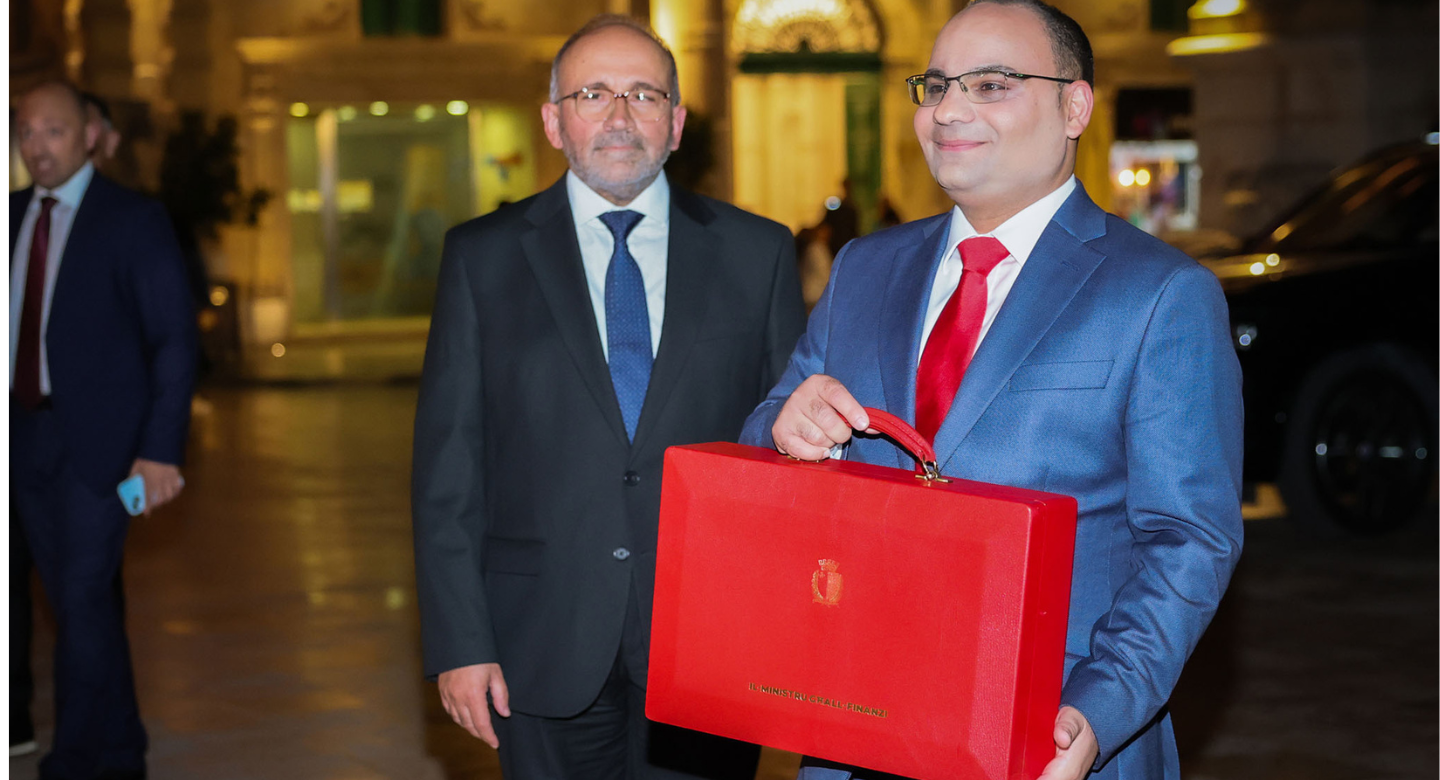

There are few things more touching than a government congratulating itself on its own generosity. There are even fewer things more touching than a prime minister embracing his finance minister in Parliament, apparently overcome by the sheer brilliance of a budget.
On Monday evening, Prime Minister Robert Abela wrapped his arms around Finance Minister Clyde Caruana at the conclusion of the Budget 2027 speech. Caruana had just announced that Labour would deliver its much-discussed ‘Super Bonus’ after all.
The scene would have been less touching had Caruana not spent the preceding weeks warning that public finances had to be protected, energy subsidies were the priority, and the ‘Super Bonus’ might have to wait.
In September, he said he was not prepared to compromise either the protection of energy prices or the health of public finances for another measure. The bonus, he said, was a manifesto commitment to be implemented over five years.
Apparently, the five-year plan has been shortened by the inconvenience of having to explain to voters why the headline promise in Labour’s electoral campaign might not materialise.
So third-country nationals (TCNs) come into focus.
The workers who built the model are now the problem
The most revealing feature of this budget is its treatment of workers from outside the EU. They have been central to Malta’s economic expansion, filling vacancies in hospitality, construction, care, transport, retail and other sectors.
Now, some of those same workers are being told that their contribution to the country does not quite qualify them for the same treatment as everyone else.
From 2027, TCNs who have not been resident in Malta for five years will lose access to free public transport and free childcare, subject to the arrangements for children already using childcare.
They will also lose eligibility for the payment associated with atypical working hours. Work-permit application fees will rise from €600 to €800, while a new €400 infrastructure contribution will apply to new applications and renewals. Additional charges will affect some driving licences.
The government expects the changes affecting TCNs to generate approximately €46 million through additional revenue and savings. Higher work permit charges alone are expected to generate some €80 million.

There is an especially delicious irony in the fact that the minister presenting these measures is the same Clyde Caruana who helped shape Malta’s labour-market strategy when he headed JobsPlus.
Caruana was chief executive of the state employment agency between 2013 and 2019, during the period in which Malta’s economy increasingly relied on imported labour to sustain its rapid expansion.
He was not a detached observer watching this model develop from the sidelines. He was part of the machinery through which it was promoted and administered.
In 2024, Caruana acknowledged that Malta’s economy would collapse without TCNs. He also argued that the country needed to move away from labour-intensive, low-productivity sectors towards higher-value economic activity.
His concern about the sustainability of the existing model was legitimate. The question is why the people being asked to pay for its shortcomings are the workers who came here to fill the jobs that the economy generated.
If Malta has become too dependent on imported labour, that is not the fault of the people who accepted jobs here.
If infrastructure has failed to keep pace with population growth, that is not the fault of the people who travel on overcrowded buses or struggle to find affordable accommodation.
If businesses have built their operations around a plentiful supply of foreign workers, that is not the fault of those workers either.
These were policy choices.
Since 2013, Labour governments have encouraged an economic model that prioritised rapid growth and business expansion. Now, the government wants to change direction.
That is its prerogative. Yet charging workers more for permits, transport and essential services does not, by itself, create better jobs, improve wages, build infrastructure or make businesses more productive.
Malta’s own labour-migration policy acknowledges that foreign workers account for around a third of the workforce and are essential to economic growth and the delivery of services. That is a substantial dependency to develop before suddenly discovering that foreign labour comes with costs.
A government can blame population pressure on the visible presence of foreigners much more easily than it can explain years of planning failures, infrastructure deficiencies and decisions that rewarded economic growth without adequately accounting for its consequences.
The ‘Super Bonus’ and the economics of a hug
When the finance minister questioned whether the ‘Super Bonus’ could be delivered without compromising other priorities, he was acknowledging a genuine trade-off.
When the government decided to deliver it anyway, that trade-off did not magically disappear. It became a question of how the commitments would be financed and which other priorities would have to accommodate them.
The budget’s new charges and restrictions on TCNs are one part of that equation. Higher tourism taxes are another. The government is raising additional revenue from tourists and foreign workers while retaining costly commitments it had previously presented as difficult to reconcile.
The ‘Super Bonus’ is the present to the electorate. The new charges are part of the bill.
While the government can decide how it raises revenue, distributing that burden is a political choice.
If the government wants to change Malta’s economic model, it should take responsibility for the model it helped create.
If it wants to reduce dependence on cheap labour, it should explain how businesses will be encouraged to invest in productivity and pay better wages.
If it wants to charge for infrastructure, it should demonstrate how the money will improve infrastructure. And if it wants to preserve expensive subsidies and deliver an electoral bonus, it should explain the full cost and the financing choices involved.
It should stop treating people as though they were responsible for the failures of the people who governed them.
‘Malta Miegħek’, the budget is called. Malta with you.
Unless, apparently, you have been here for less than five years, in which case the bus fare is extra.
Sign up to our newsletter Stay in the know
"*" indicates required fields

Watchdog exposes government recruitment chaos but keeps ministries unnamed

VAT lottery changes follow scrutiny over suspicious repeat wins

Charter flight and pocket money paid by taxpayers for mayors’ botched papal audience

King Corrupto and the blame game

Tags
#Finance Minister Clyde Caruana
#Malta Budget 2027
#Malta Prime Minister Robert Abela
#TCNs
#Third Country Nationals
Other News
Watchdog exposes government recruitment chaos but keeps ministries unnamed
VAT lottery changes follow scrutiny over suspicious repeat wins
Charter flight and pocket money paid by taxpayers for mayors’ botched papal audience
King Corrupto and the blame game

€9 million splashed on government boards as wives also benefit irregularly

Indian students up 35%, Chinese 29%, Maltese down 2.2% in a year
Retired judge handed €72,000 salary and chauffeur to monitor government advertising
€1 billion in government tenders challenged in 2025

Wasteserv, Dalli in reverse mode

Court cuts short PBS attempt to slow down PN case over bias

Unemployed ‘loan shark’ has nearly €700,000, 15 vehicles and 19 properties frozen