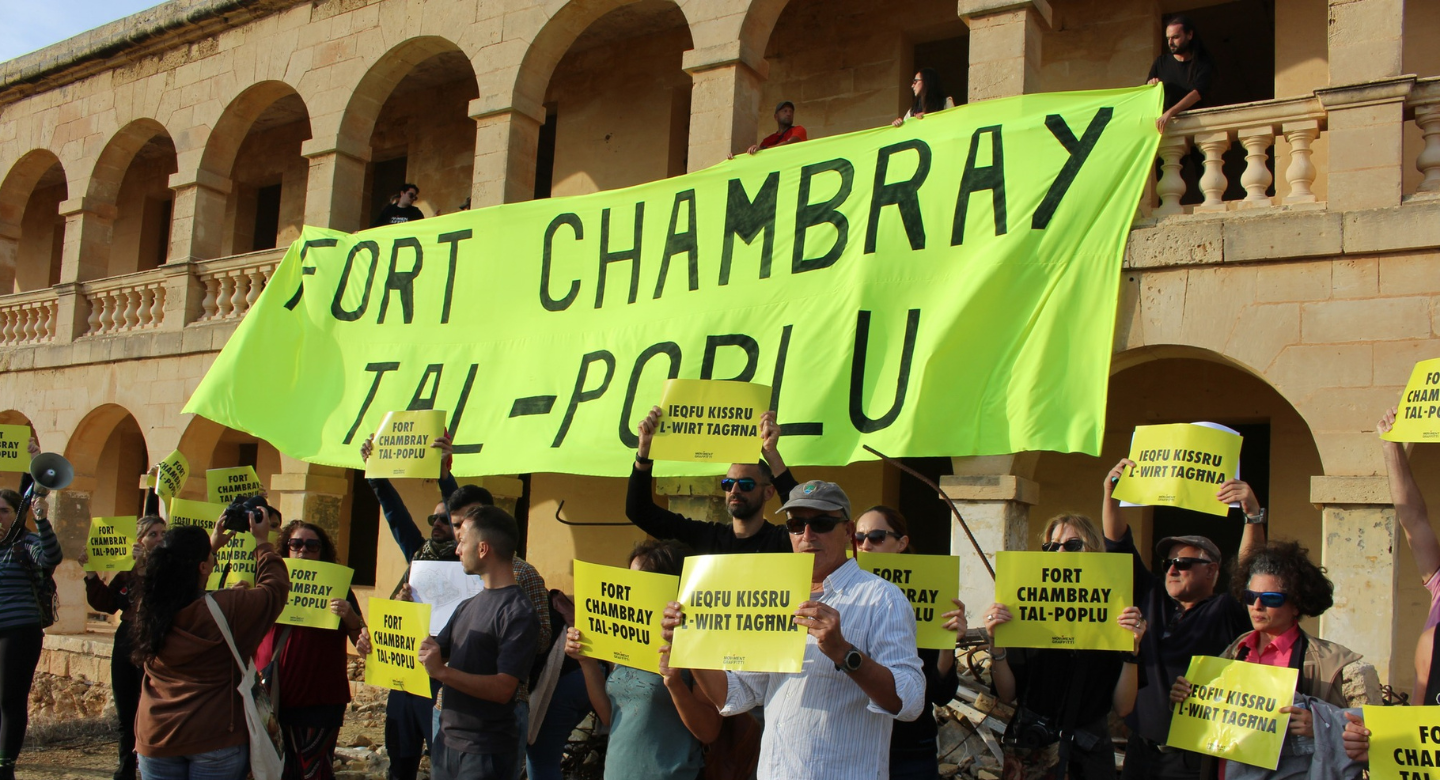

Maltese taxpayers may be required to spend more than €6 million restoring Fort Chambray’s deteriorating fortifications, while the public remains largely excluded from the privately developed historic site and its British-era barracks face demolition.
A new report by Europa Nostra calls for the British Barracks to be granted immediate Grade 1 protection. It also urges the government to consider recovering the building and surrounding land for public ownership, similar to what happened at Manoel Island.
The report was prepared under Europa Nostra’s Most Endangered Programme following an expert mission to Malta and Gozo.
Planning permission granted in December 2024 would allow the historic barracks to be demolished to make way for a five-storey spa hotel, according to the report. Ninu Fenech’s Tum Invest and Gozitan developer Francesco Grima are among those behind the development.
Under the approved proposal, the building’s characteristic two-storey arcade would be dismantled and reconstructed against the new hotel’s façade.
Europa Nostra argues that this would preserve only the appearance of the barracks while destroying the original masonry, internal divisions, circulation galleries and relationship between the building and its military surroundings.
“The issue is therefore not simply whether the familiar arcaded façade survives,” the report states. “It is whether the British Barracks survive as a historic building.”
The barracks were built between 1895 and 1903 to accommodate married British soldiers and their families. They were later used for military medical purposes during the First World War and served as Gozo’s leprosy hospital from 1937 to 1956.
Despite this history, the building remains unscheduled.
Europa Nostra says comparable, and more recently constructed, military quarters elsewhere in Malta and Hong Kong have received Grade 1 protection.
The report also raises questions about the use of public money at a site that now operates substantially as a private residential complex.
Under amended concession arrangements described in the report, developers may carry out restoration and stabilisation works costing up to €6 million and receive reimbursement from the government. That ceiling may be increased by agreement.
Europa Nostra warns there is no reliable published estimate of the final cost.
Geological instability and extensive deterioration affecting sections of the fortifications mean the eventual bill could be considerably higher.
The report says meaningful public access has not been provided despite access provisions in the earlier concession and planning framework. It claims the fort’s gates have remained closed and that a large swimming pool was constructed across one of the routes designated for public access.
“The substantial commitment of taxpayers’ resources” strengthens the case for treating Fort Chambray as a public heritage asset, the experts argue.
As an alternative to demolition, Europa Nostra proposes converting the barracks into a Centre for Innovation and Heritage, incorporating research, start-up, training, cultural and public-interpretation facilities.
Its preliminary economic model estimates that renovation and landscaping would cost €1.864 million, excluding property acquisition and fortification works. It projects an annual net economic benefit of approximately €124,000 and a real return of 4.4% over 25 years.
Those figures remain indicative and would require a detailed structural survey and feasibility study.
The report recommends making the restored barracks part of Gozo’s proposed European Capital of Culture programme in 2031, providing a deadline for intervention and leaving a permanent public asset rather than “a temporary programme of events”.
Sign up to our newsletter Stay in the know
"*" indicates required fields

Dizz repays €8 million bond after completing Tigne shopping mall company sale

PN loses more experience as Alex Borg sacks his spokesman


Abela gets another drubbing by PL delegates

Galdes ‘parked’ at National Skills Council
Tags
#British Barracks
#Europa Nostra
#Fort Chambray
Other News
Dizz repays €8 million bond after completing Tigne shopping mall company sale
PN loses more experience as Alex Borg sacks his spokesman
Abela gets another drubbing by PL delegates
Galdes ‘parked’ at National Skills Council

MTA in financial meltdown

International press freedom groups urge Abela to open media bill to scrutiny
Buttigieg stops short of direct action against Carlo Stivala’s new illegal structure

Revealed – Minister awards €53,300 property lease direct order to his own agency chair
PA postpones Saqqajja flats decision amid ground stability concerns

Convicted PL executive candidate given promotion before election

Galdes points fingers at Owen Bonnici over latest social housing standstill