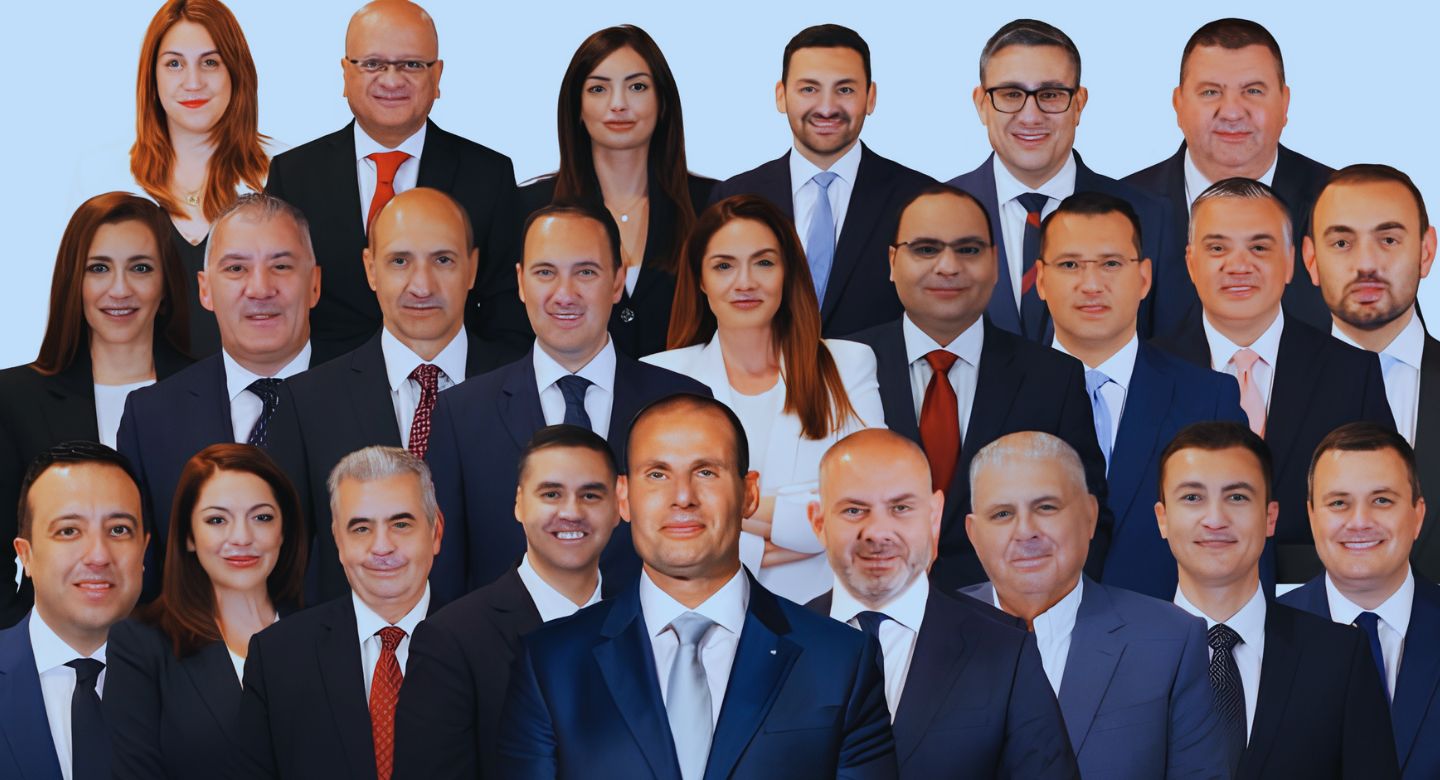

Robert Abela’s latest Cabinet formation has reached its largest size in modern history, with 20 ministers forming the most expansive ministerial team the island has ever had.
The new government executive also places Malta firmly at the upper end of European Union governments in terms of ministerial size, particularly when measured against the country’s already bloated parliamentary base of 79 MPs.
While Cabinet size is often presented as a matter of political balance, the structure also carries a significant financial and administrative burden.
Ministries increasingly resemble small government departments in their own right, each supported by layers of political appointees operating alongside the permanent civil service.
Using standard Maltese public-sector cost benchmarks for political offices, including the official Office of the Prime Minister resourcing framework that determines the size of ministerial secretariats, The Shift estimates an annual cost of ministerial and parliamentary secretariat structures of approximately €18.2 million.
This figure reflects only the political layer of government: ministers, parliamentary secretaries, and their personal secretariats. It excludes the civil service, departmental operations, consultants, advisers, and wider government expenditure.
According to the OPM manual, each minister is entitled to a secretariat of up to 19 staff, largely composed of persons of trust. On official salary scales, these structures can cost in the region of €800,000 per minister per year, before accounting for additional policy consultants or supplementary staffing arrangements.
In practice, ministers also engage, mostly irregularly, additional personnel across government-linked entities or agencies where political influence can extend, further increasing the indirect cost footprint beyond formal secretariat limits.
The current Cabinet structure also reflects a clear political choice by the Prime Minister, who, rather than consolidating portfolios, opted for a higher number of full ministerial posts, distributing responsibilities more widely across his parliamentary group.
The result is a government in which more than half of the governing MPs hold ministerial office, raising questions about the concentration of executive roles within a relatively small legislature.
OPM sources said that the Prime Minister, at the expense of appearing weak or not fully in control, opted to bow to pressure and appointed as many ministers as possible, also to dilute internal opposition from a few ministers.
A Cabinet at the upper end of EU scale
Across the European Union, cabinet sizes vary significantly, but Malta now sits at the upper end of the spectrum in terms of ministerial numbers.
Larger member states such as Germany, France, and the Netherlands have fewer ministries than Malta despite far larger populations and more complex administrative systems.
With 20 ministers drawn from a parliamentary group of less than 40, Labour’s Cabinet remains one of the most executive-dense parliamentary systems in the EU.
Abela’s latest cabinet reflects a broader trend that has developed since Labour came to power in 2013, when Maltese governments began gradually expanding the number of ministries and increasing reliance on parliamentary secretaries and political appointees.
Over time, portfolios that were once grouped under broader ministries have been divided into smaller units, each with its own political leadership and administrative structure, so that more MPs could become ministers, although with significantly less clout.
The system permits more opportunities for Labour to distribute political favour, making voters more dependent on political patronage.
Sign up to our newsletter Stay in the know
"*" indicates required fields

International press freedom groups urge Abela to open media bill to scrutiny

Buttigieg stops short of direct action against Carlo Stivala’s new illegal structure
Revealed – Minister awards €53,300 property lease direct order to his own agency chair
PA postpones Saqqajja flats decision amid ground stability concerns
Tags
#Cabinet
#costs
#inefficiency
#Ministers
#Robert Abela
Other News
International press freedom groups urge Abela to open media bill to scrutiny
Buttigieg stops short of direct action against Carlo Stivala’s new illegal structure
Revealed – Minister awards €53,300 property lease direct order to his own agency chair
PA postpones Saqqajja flats decision amid ground stability concerns
Convicted PL executive candidate given promotion before election

Galdes points fingers at Owen Bonnici over latest social housing standstill
Clyde Caruana misses deficit target by €312 million

PBS ‘hides’ Ricky in response to PN court case

Bank accused of misleading prospective bond investors

Hili faces bigger battle over Comino after NGOs win reprieve
New government borrowing could cost taxpayers up to €22.5 million a year in interest

Greece,as EU country has 22 Ministers ,4 alternate Ministers and 32 Deputy Ministers with 10 milions population 🙂
Don’t worry the government plans to bring 10 trillion people to make the 20 ministries worth it
Government of hypocrisy and deceit