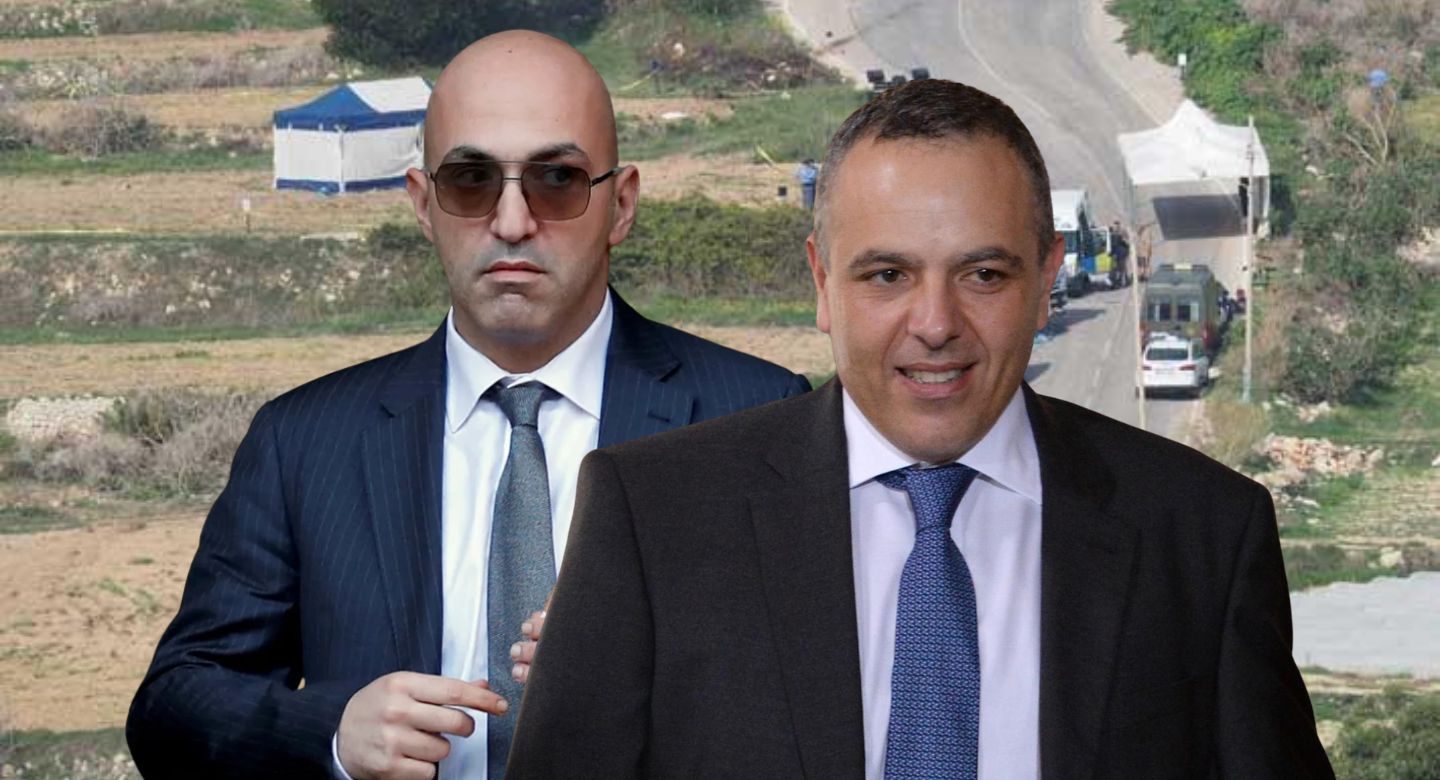
The police force’s officers testifying earlier on Friday in the murder trial in which Yorgen Fenech stands accused of the voluntary homicide of Daphne Caruana Galizia, presented hundreds of photos showing luxury vehicles, properties, firearms, and wads of cash retrieved from various locations associated with the executors who detonated the bomb that claimed the journalist’s life.
Throughout Thursday and Friday morning, almost a dozen police officers who previously formed part of the force’s forensics unit walked jurors through the scene of the crime and the additional sites which were searched after the executors and the bomb suppliers – Vince Muscat and brothers Alfred and George Degiorgio, brothers Robert and Adrian Agius, and Jamie Vella – were firmly placed on the murder investigation’s radar in December 2017.
The searches, which were carried out in collaboration with international agencies such as Europol and the Netherlands Forensic Institute (NFI), laid bare just how well-resourced the organised crime group was. The executors were arrested during the infamous raid on the Marsa potato shed on 4 December 2017, with the investigation eventually leading officers to middleman Melvin Theuma and alleged mastermind Yorgen Fenech.
Besides the crime scene itself and the potato shed in Marsa, the police raided three other sites: a garage in Żebbuġ which was used by Adrian Agius to store vehicles and equipment, Alfred Degiorgio’s property in St Paul Bay, and a farmhouse linked to Vella in Mosta.
Darren Debattista, who was a police constable at the time of the murder, said scene of crime officers collected 93 exhibits from the site, including discarded phones, SIM cards, cigarette packets and other personal items.
The executors’ boat, Maya, which the prosecution says was used to send the text that detonated the bomb, was also analysed and photographed. The analysis yielded fingerprint matches, which further confirmed the executors’ involvement in the assassination.
Jurors were also shown photographs from nearby garages in the Marsa area, where police recovered a small revolver, a Mercedes, an Audi, a Toyota Passo, a GoPro camera, small electronic devices and a hard drive.
Scene of crime officers Arthur Borg and Antoine Fenech later testified about a garage in Żebbuġ linked to the bomb suppliers. The same garage had previously been described in court as a storage site for equipment used by the executors for their criminal activity.
Jurors bore witness to photos showing mobile phones, shortwave radios, credit cards, weapons and other illicit items were seized from the garage, which also appeared to have been used as a makeshift living space.
On Friday, former police constable Patrick Grech also told the court he had been nominated by the inquiring magistrate as an exhibit officer responsible for traceability, documentation, and the maintenance of the chain of custody.
Police officer Darren Debattista further testified about the forensic examination of the remains of Caruana Galizia’s rented Peugeot 108, describing the vehicle as one of the most important individual items in the police’s evidence catalogue.
The court heard that the remains of the car were stored in a secure compound which could only be opened in the presence of a court-appointed expert. Every time the compound was accessed, it had to be resealed and photographed.
Debattista walked jurors through photographs of the vehicle’s remains, including close-up shots of the extensive damage caused by the blast.
He said investigators identified “extraneous residue” – material which did not belong to the vehicle, and tested it accordingly. He also said fuel and metal were added to the bomb to set the vehicle on fire and propel shrapnel outwards.
An identical Peugeot 108 model was used by the forensic team to help reconstruct the destroyed vehicle and distinguish between parts belonging to the car and material introduced by the bomb.
Jurors were also told how forensic officers used ballistics rods to confirm the suspected trajectory of the explosion. The rods were inserted through the outermost holes caused by the blast; because the explosion radiated outwards, the rods converged at the centre of the blast, beneath the driver’s seat.
Debattista also testified about work carried out with Europol experts to examine the exhibits and samples collected from the scene. More than 800 photographs were taken for one report alone, although the prosecution showed jurors an indicative sample.
The trial continues.
Sign up to our newsletter Stay in the know
"*" indicates required fields

Verdict: 8-1 – Yorgen Fenech not guilty


‘May God help you in your decision’: Fenech jury begins deliberations
Judge expected to wrap up trial tomorrow

Judge: Theuma’s pardon does not make his testimony automatically true
Tags
#Adrian Agius
#Alfred Degiorgio
#Daphne Caruana Galizia
#Europol
#George Degiorgio
#Jamie Vella
#Maksar
#malta police force
#Netherlands Forensics Institute
#Robert Agius
#Vince Muscat
#Yorgen Fenech
Other News
Verdict: 8-1 – Yorgen Fenech not guilty
‘May God help you in your decision’: Fenech jury begins deliberations
Judge expected to wrap up trial tomorrow
Judge: Theuma’s pardon does not make his testimony automatically true

Where are the messages between Keith Schembri and Keith Arnaud? – defence asks
Theuma promised pardon before Fenech’s arrest, defence tells jury

Prosecution tells Fenech jury it wants ‘the whole truth’ uncovered

‘Keith Schembri effectively gave himself a pardon’, Fenech defence claims
Fenech defence: Evidence pointing to Keith Schembri was deliberately blocked by police
Fenech defence alleges ‘cover-up and frame-up’ as testimony ends

‘If I could turn back time’: Fenech challenged over failure to report murder plot